


Compare spraying interior doors off the hinges with brushing them in place. Covers prep by door type, sheen, drip control, drying time, paint quantity and what affects a painter's quote.
Spraying doors off the hinges gives the smoothest, most even finish and goes faster. Brushing and rolling in place can also look good if you remove the hardware, use thin coats and watch for runs. Prep matters more than the method, and semi-gloss is the usual durable sheen for doors and trim.
Spraying off the hinges or brushing in place: which finish is better?
Spraying off the hinges gives the best finish. Benjamin Moore says spraying doors can provide a beautiful, smooth finish and is faster, and its portable spray booths keep overspray out of living space. Its own door guide notes that many professional painters suggest removing doors and laying them on sawhorses, which gives the best results.
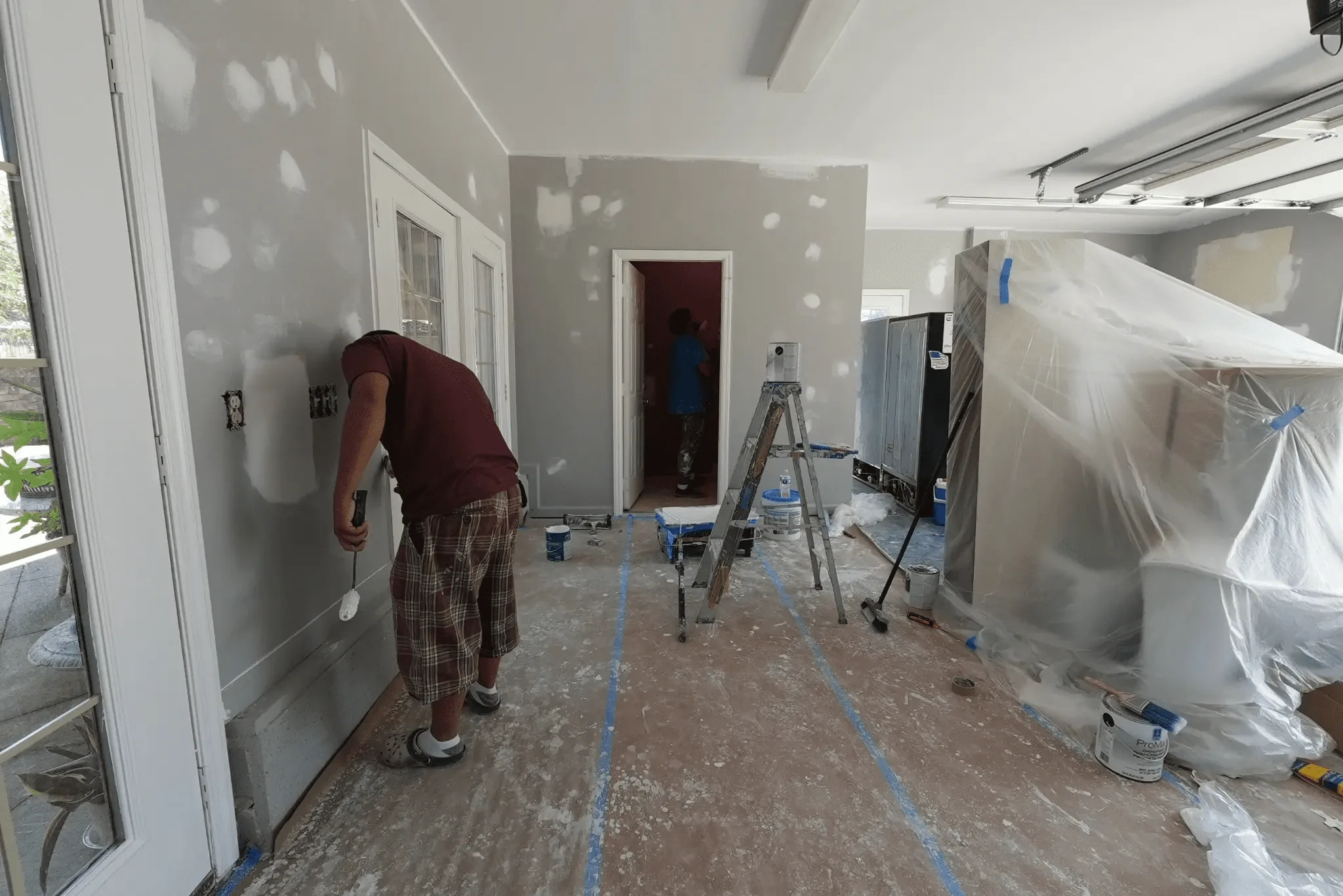
Painting in place has real limits. Taping the hardware and painting around it is less preferred because it can leave brush marks from cutting in. A door left on its hinges also tends to drip and sag across the panel moldings and bottom corners, according to True Value. A door in good condition, handled carefully, can still turn out well.
How to decide between spraying and brushing
Spray when you have many doors, panel doors or a worn finish, and you can contain overspray. Brush and roll when it is one or two flat doors in good shape and nobody wants a spray setup in the house.
Panel doors favor spraying because the recesses hold brush marks and pooling paint. Flat doors roll well. Hardware matters too: if the hinges are painted over or the knobs are fragile, taking everything off and labeling it keeps the job clean. Ask how much floor space you can give up, since doors drying flat need room.
How do you prep an interior door so paint sticks?
Remove the hardware, degrease, fill dents, sand lightly, wipe off the dust and prime where needed. Sherwin-Williams recommends washing with a degreasing dish soap, rinsing with a clean damp cloth, sanding smooth and wiping the dust off. If the door has not been painted or primed, apply primer and let it dry completely.
Door handles collect skin oils, so the area around the knob needs the most attention. Home Depot suggests filling holes and repairing imperfections with sandable filler or spackle, then gently sanding with 120-grit sandpaper. In humid South Florida homes, make sure bare edges are fully dry before priming.
Prep by door type
Pre-primed doors need only a light scuff, while other door types each need their own primer and grit. The table below pulls the published guidance together.
| Door type | Sanding | Primer note |
|---|---|---|
| Pre-primed | Go easy to avoid scuffing off the primer (The Spruce); light 180-grit sanding helps adhesion (Home Depot door care guide) | Usually none needed |
| Bare wood | Medium 220-grit paper on a sanding block (Fine Paints of Europe) | Two coats of interior primer (The Spruce) |
| Previously painted | Sanding removes old coating and gives paint a better surface to hold (BHG) | Prime bare or glossy spots |
| Vinyl-covered | Sand first (BHG) | At least one coat of primer after sanding (BHG) |
| Steel | 220-grit on a backing block (Fine Paints of Europe) | Ferrous metal primer (Fine Paints of Europe) |
| Fiberglass | Fine 400-grit paper (Fine Paints of Europe) | Key Primer (Fine Paints of Europe) |
Clear pine and unfinished veneer doors are meant to be stained and clear-coated, not painted, according to The Spruce.
Which paint and sheen work best on doors and trim?
Semi-gloss in a durable acrylic is the usual choice. BHG recommends a semi-gloss or glossy sheen because it stands up to everyday use and frequent cleaning.
Gloss is an option if you accept that it shows every flaw in the surface. On older doors with dents or patched areas, semi-gloss hides more.
How do you brush and roll a door in place without drips?
Use thin coats, a lightly loaded angled brush on the panels first, a foam roller on flat areas and a light tip-off at the end. True Value says not to overload the brush, and to start with the panels and work from the inside out. A mini foam roller gives a smooth finish on a smooth door.
Watch the corners and top moldings of each panel, where paint builds up. Dab with the bristle tips, smooth runs with an upward stroke, then tip off with a dry brush. With latex, work fairly quickly, because brushing back into areas that have started to set leaves marks. Humidity keeps paint open longer, so check for runs and sags after you finish.
When can the door be closed?
Paint the closing edge first, which gives it more time to dry and helps keep the door from sticking. Then let the paint cure at least one or two days before closing the door, per True Value. Painter's tape on the jamb also helps prevent sticking.
What does it take to spray doors safely and cleanly?
You need a contained space or booth, ventilation, masking, an HVLP or airless sprayer and a rack for drying. Benjamin Moore notes that most sprayers handle primers, paints and stains, and that HVLP sprayers produce less waste. Racking systems stack several doors at once and take up less of the homeowner's space.
Mask everything near the spray area, keep air moving and check panels for pooled paint after spraying. Cabinet doors are typically handled in a similar contained setup, and a cabinet refinishing timeline shows how that flow works.
How much paint do interior doors need?
About 4 gallons covers ten doors at two coats. The Spruce puts each interior door at about 68 square feet including front, back and edges, and one gallon at about 350 square feet. Ten doors at 68 square feet is 680 square feet per coat.
How much does it cost to have interior doors painted?
Price depends on door count, door style, condition, spraying versus brushing, and whether trim is included. A flat per-door figure rarely makes sense, because a flat panel door and a worn six-panel door are different jobs. Our room-by-room interior painting cost post shows what moves a quote, and a written scope should list how many doors, the prep, the primer and the finish coats.
If your project goes beyond a home, see how we break down a commercial interior quote, or look at our Plantation commercial painting page. Contact PaintPro South Florida to get started.