


Learn how to paint wood veneer cabinets without sanding through the thin wood layer. Covers telling veneer from laminate, repairing edges and chips, choosing a bonding primer and enamel, and what to ask a painter.
Yes, you can paint wood veneer cabinets, and they hold paint well as long as the prep accounts for how thin the real wood is: it's a skin over a core. Re-glue lifted edges, fill chips, scuff lightly enough that you never cut through, then use a bonding primer and a cabinet enamel.
Is it wood veneer or laminate?
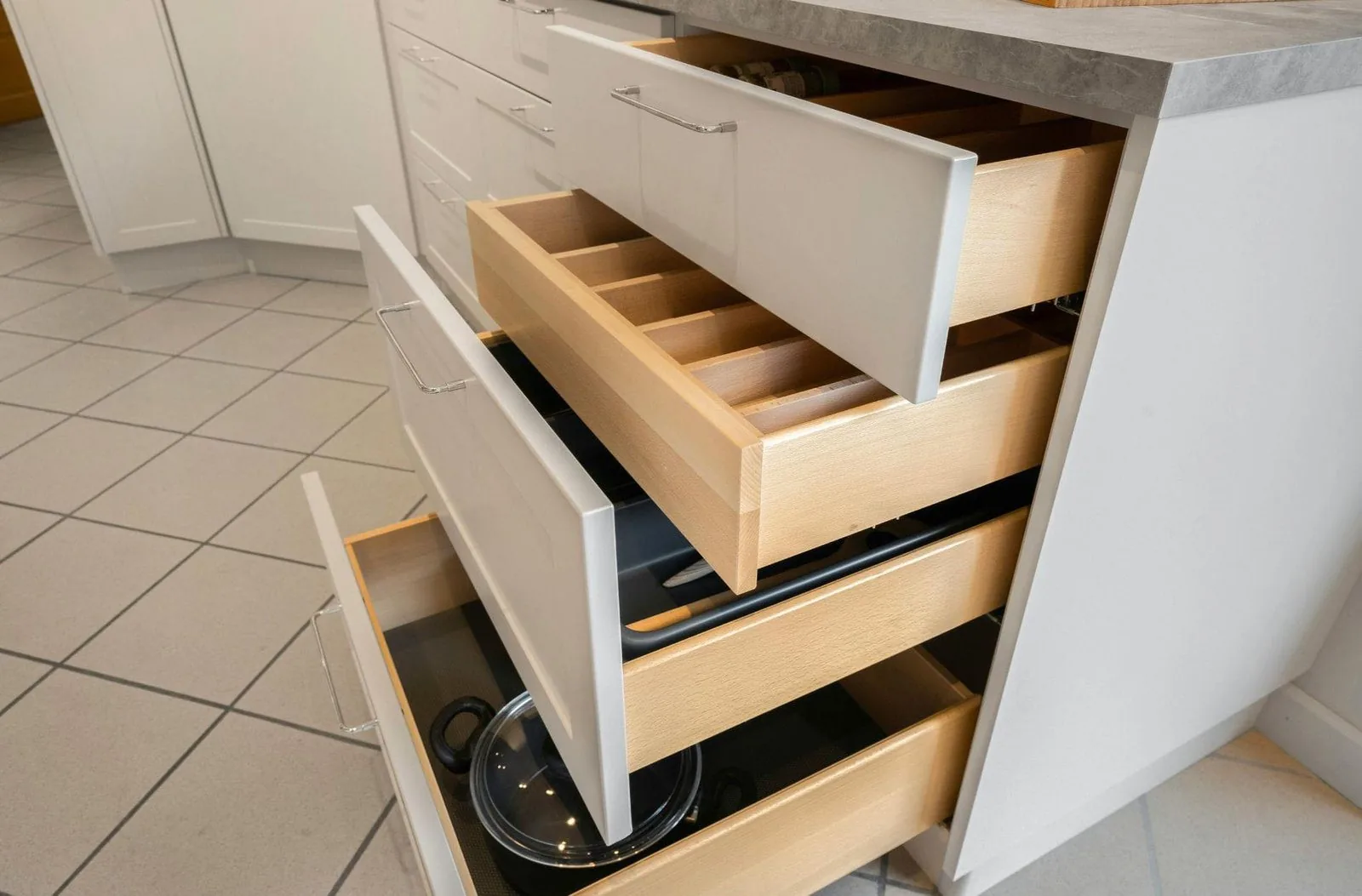
Look at an unfinished edge, such as the inside of a door or the cut edge of a shelf. Wood veneer is a thin layer of real wood, so look for natural, non-repeating grain and a thin line where the skin meets the core. Laminate is a plastic-based surface that can carry a printed wood pattern. If you can't tell, have a painter look before you sand.
What you find decides how you sand and which primer you use. Sanding, filler and primer all get a grip on real wood, but a plastic face gives primer almost nothing to hold, which is why laminate needs a stronger bonding primer. If yours is plastic, our post on painting laminate cabinets covers that case.
| Wood veneer | Laminate | Solid wood |
|---|---|---|
| What it is | Thin layer of real wood over a core | Plastic-based surface |
| Sanding | Light scuff only | Light scuff |
| Primer | Oil-based, shellac-based or high-adhesion bonding primer | Stronger bonding primer |
| Main failure risk | Sanding through the veneer; lifting edges | Paint not gripping the slick face |
Check edges and chips first
Go door by door and decide what each one needs before anyone touches sandpaper.
- Lifted or bubbling edge: glue it with wood glue and clamp it until fully cured. Paint over a loose edge and it will peel with the veneer.
- Chip or missing veneer: pack the gap with a veneer patch or wood filler, taper the repair out past the edges of the chip, and sand it flush.
- Sanded-through or bare spot: the core is showing. Treat it like missing veneer: fill it with a veneer patch or wood filler and sand it flush before priming. If the spot is large or the core looks swollen, have a painter judge whether the door needs more than paint.
- Intact wood veneer: clean, scuff, prime.
- Laminate: switch to the laminate approach and the stronger primer.
In kitchens, the doors nearest the sink and dishwasher see the most moisture and handling. Check those first.
How much sanding veneer can take
Veneer is thin, so use the gentle end of every range. Before priming, and after degreasing, you're only scuffing the surface to give the primer some tooth. One guide puts that at 120 to 180 grit; another says 220. On veneer, stay at 180 to 220 and use a sanding block, which keeps pressure even and protects the skin. Sand with the grain, and ease off at edges and corners, where pressure concentrates and it's easiest to cut through.
Once the primer is on, Sherwin-Williams has you let it dry at least 24 hours, then sand again with "very fine" grit and wipe with a damp cloth to clear the dust. This pass only smooths the primer: it removes nibs and raised grain and barely touches the veneer underneath.
Primer, enamel and dry time
The primer has a lot to do with how long the finish lasts. For veneer, use an oil-based or shellac-based bonding primer, or a high-adhesion bonding primer. Shellac-based types also block stains and wood bleed-through. A general wall primer is the wrong product on a slick, sealed face.
Test first. Sherwin-Williams suggests applying a test sample of Extreme Bond Primer on an inconspicuous spot and checking adhesion once it's dry. A surface that isn't clean, dry and dull won't bond as well, so degrease thoroughly before that test, including old residue like tape glue.
For the topcoat, skip wall paint and use a cabinet or trim enamel. Satin or semi-gloss wears well. Apply several thin coats; one thick coat drips and traps moisture. Sherwin-Williams allows 24 to 48 hours per coat of cabinet paint, and the same again after the second coat before the hardware goes back on. Paint keeps hardening after it feels dry, so handle freshly hung doors gently for a while. Our post on how long cabinet refinishing takes walks through that timing.
Having veneer cabinets painted in Broward
Our crews take the doors off, degrease and sand them, lay down a bonding primer, then spray the enamel in a contained area. On veneer we keep the sanding light because the wood layer is thin.
Ask for a written scope that lists door repairs separately from painting, along with the warranty terms. Ours is a written 2-year warranty covering labor and materials. If you live in Davie or nearby, see our Davie painters page. See how we lay out a commercial interior painting quote (the same itemized approach applies to cabinets), then request a free estimate so someone can look at your doors before any paint goes on, and point out any edges you've noticed lifting.