



Work out paintable area, gallons and a dollar range for your home's exterior, with a worked two-story stucco example, per-square-foot benchmarks by siding type, and a DIY versus hire comparison.
Multiply your wall perimeter by wall height and subtract 15-20% for windows and doors to get paintable area. Divide by 250-400 square feet per gallon, double for two coats, and multiply the area by an outside per-square-foot benchmark for a cost range.
How do you calculate paintable square footage?
Measure the perimeter of the house, multiply by wall height, add the gables, and subtract the openings. Paintable area is wall surface, not floor area.
Family Handyman suggests sketching each side as rectangles and triangles. Measure each shape, round up to the nearest foot, and multiply length by height. For a triangle, multiply length by height and divide by two. Treat each gable as half a rectangle.
A costtorenovate guide gives a shortcut: about 9-10 feet of wall per story, or 18-20 feet for a full two-story wall. Then subtract 15-20% for windows, doors and the garage door.
If you want to count openings one by one, HomeAdvisor uses about 21 square feet for a standard door and about 12 for an average window.
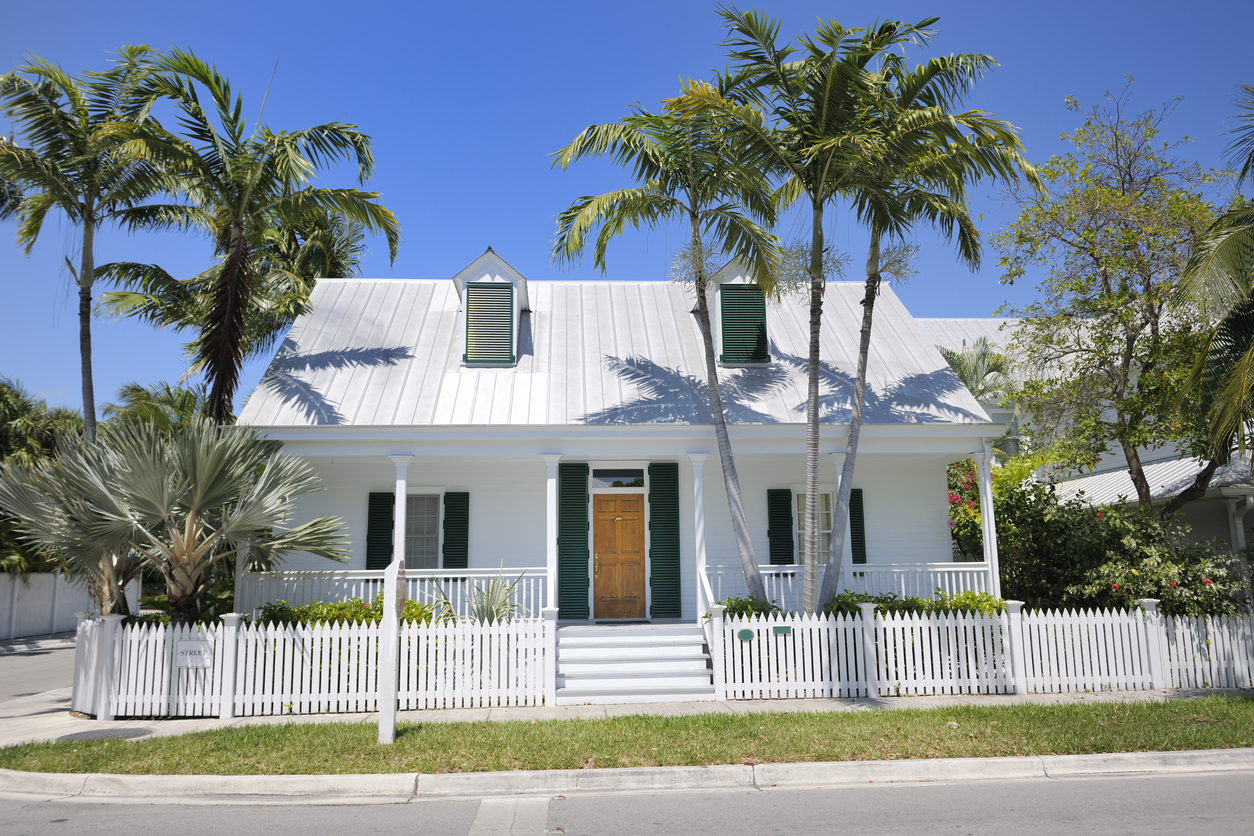
Worked example: a two-story stucco house
A 40 by 25 foot two-story house comes to about 2,025 square feet paintable, 6-9 gallons per coat (doubled for two coats), and roughly $3,000-$8,100 on outside stucco benchmarks.
Here is the arithmetic. The perimeter is 2 × (40 + 25) = 130 feet. At 19 feet of wall height, that is 130 × 19 = 2,470 square feet. Taking 18% off for openings leaves about 2,025 square feet of paintable wall.
For gallons, divide 2,025 by 400 square feet per gallon at the best case and by 250 at the worst case, which gives about 6-9 gallons for one coat after rounding up. Two coats double that, so buy twice the one-coat quantity.
For cost, Angi lists stucco at $1.50-$4 per square foot. That gives 2,025 × $1.50 = $3,038 at the low end and 2,025 × $4 = $8,100 at the high end. This is an outside benchmark, not a quote.
What does exterior painting cost per square foot?
Outside benchmarks cluster near $1.50-$4 per paintable square foot, and the higher figures usually assume two coats and standard prep.
HomeAdvisor puts the 2025 range at $1.50-$4 per square foot, with a $3,178 average, and adds 10% to 15% to its figures as a buffer for unforeseen problems. The Spruce quotes $1 to $4 per square foot on an average job near $3,000, with a range of $1,900 to $6,900.
Costtorenovate's 2026 guide sits higher at $2.50-$5.00 per square foot of paintable wall. It assumes a professional two-coat job with standard prep, and says labor takes 65-75% of the job. Its rates for floor area are lower, $1.75-$3.45 for one-story homes and $2.40-$4.55 for two-story homes, because the base is different.
So a gap between sources usually comes down to the base (wall or floor area), the number of coats and how much prep is included. Check which basis a figure uses before you multiply.
How does siding type change the rate?
Porous surfaces such as stucco and brick cost the most, while metal and vinyl cost less. Wood falls in between because it often needs scraping and patching first.
The per-square-foot figures by siding from fixitcost (2026, national, paintable wall with labor and paint included) are:
| Siding | Price per sq ft |
|---|---|
| Stucco | $2.05–$4.70 |
| Brick | $2.30–$4.95 |
| Wood | $1.85–$4.60 |
| Vinyl | $1.95–$4.45 |
| Aluminum or metal | $1.95–$3.75 |
Prep explains much of the order: wood often needs scraping, patching and extra coats, stucco is porous and takes more paint, and brick is porous and hard to reach. Stucco needs crack patching and an elastomeric paint, one that stretches and contracts with the wall. Brick needs significant cleaning and primers made to breathe. Wood needs scraping, sanding and priming. Vinyl mostly needs a thorough cleaning and a paint made for vinyl.
How many gallons of paint and primer do you need?
Divide paintable area by the coverage per gallon and double the result for two coats. Sherwin-Williams says a gallon generally covers 250-400 square feet and recommends two coats, with the first fully dry before the second.
Texture decides where you land in that range. Rough or porous walls sit at the low-coverage end, so a stucco house needs more gallons than smooth siding of the same size. Benjamin Moore notes that stucco can require more paint and take longer to dry. Most online calculators assume one coat, so doubling the output is on you.
Bare, chalky or patched areas also take primer, which seals the surface so the topcoat grips. Plan a separate primer quantity for those spots, and round up so you never run short on a wall.
What pushes the price up or down?
Prep, repairs, number of stories, trim and paint quality move the cost more than size does. A small house with mildew and cracked stucco can cost more than a larger, well-kept one. For a closer look, see what drives house painting cost.
Two stories need more time and safety equipment than a ranch of the same wall area. Trim, doors, a garage door and fascia are often priced on top of the wall rate, so list them separately. Premium paint costs more per gallon, though labor is most of the bill, so a better coating adds less to the total than extra prep does. Keep a 10-15% buffer for hidden damage you find once the old paint is scraped.
What prep does an exterior need, and what does it add?
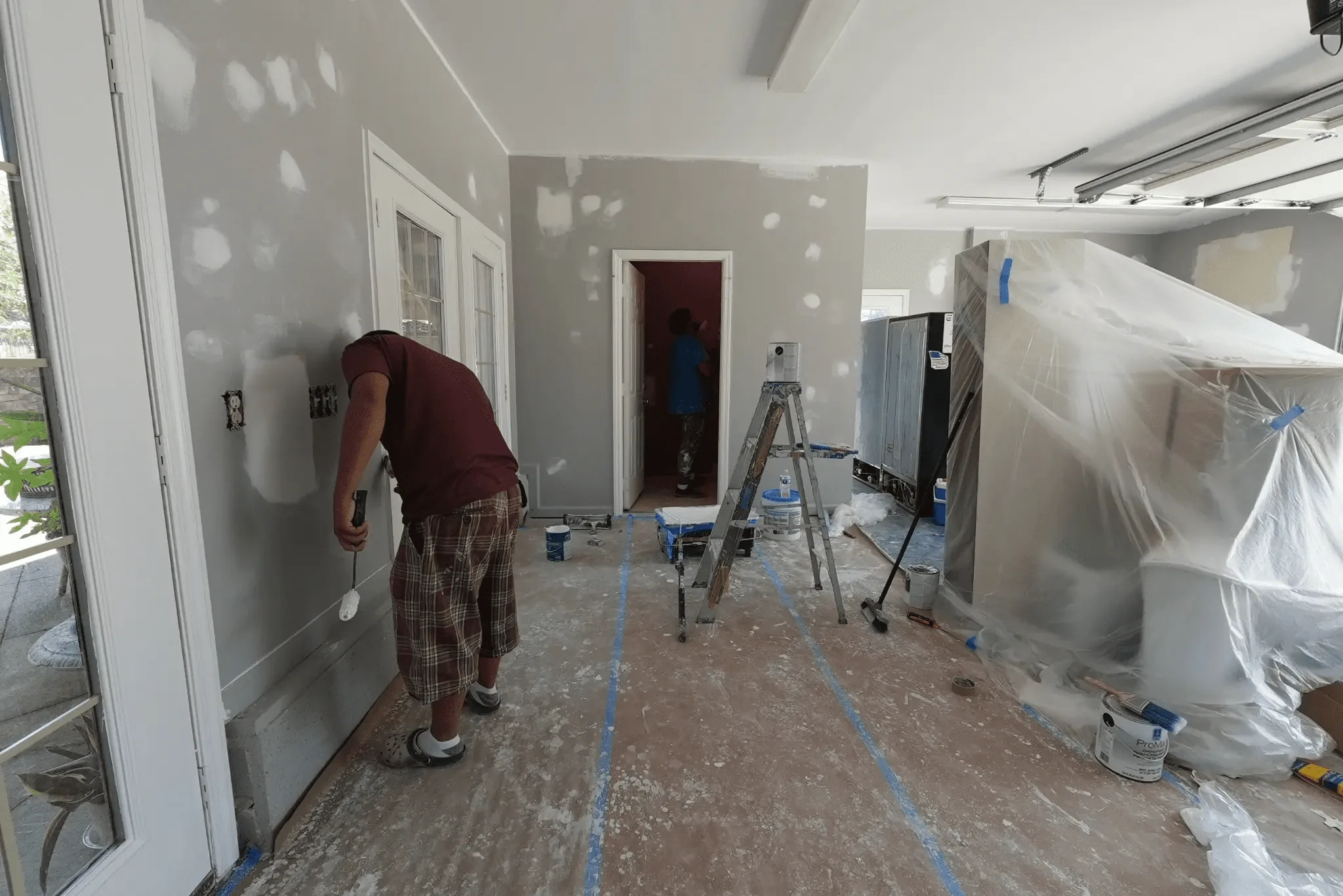
Pressure-clean, treat mildew, fill cracks, scrape loose paint and prime bare or chalky areas. Prep is the largest share of labor and the main reason a job takes days longer than the painting itself.
In South Florida, humidity grows mildew fast, and salt air and sprinkler rust stains need dealing with before color goes on. Mildew has to be treated, not just painted over. Stucco cracks must be filled, and Benjamin Moore advises waiting seven to 10 days after larger repairs before painting old stucco. New stucco should wait at least 60 days.
Afternoon storms shape the schedule, too. Dry mornings suit exterior work, and the best time for exterior painting in Fort Lauderdale is worth a read before you book.
Should you DIY or hire a painter?
DIY saves the labor share but costs time and equipment. Two stories and cracked stucco favor a professional.
Benjamin Moore's stucco tool list shows the scope: ladder or scaffolding, pressure washer, brushes, roller with extension pole, clear acrylic caulk, a patching kit and an optional sprayer. Add the dry time between prep steps and coats, and a weekend job often becomes weeks of weather-dependent work.
Choose DIY if the house is one story, the walls are sound and you have the tools or are happy to rent them. Hire out if you need lifts or scaffolding above the first floor, if the stucco has more than hairline cracks, or if an HOA expects a particular process.
How do you turn the calculator number into a real quote?
Use your range as a benchmark, then have someone look at the walls. These figures are outside benchmarks, not PaintPro prices.
Our estimate sets scope from the surface itself: condition, access, prep and any association rules, rather than a rate card. Compare your paintable-area math against the actual house before buying paint. Request an estimate from PaintPro South Florida, or browse more advice on the PaintPro blog. Visit PaintPro South Florida to get started.